
March 14, 2026
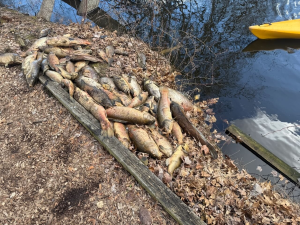
Massive Fish Die-off @ Celery Farm
A huge thank you to the volunteers who pitched in today to remove all those dead fish from the Celery…

Marsh Warden Mike Limatola reports:
While taking a group of Allendale Webelos Scouts around the preserve yesterday, we were again attacked by Yellow Jackets about 150 feet north of Pirie Platform.
One of the den mothers was stung four times and the young daughter of another den mother was stung twice.
Considering this problem has caused several people to go the hospital and many others badly hurting, I went in today and located and destroyed the nest.
It was a ground nest about a foot off the trail in the grass and they would attack when anyone came near it. They were Yellow Jackets and ranged in size from about 3/8 to 3/4 of an inch.
(Great job, Mike!)

I would like to clarify the previous comment I made about the bad reputation for stinging attributed to honeybees. I did not mean to imply that honeybees do not sting. If you ask a roomful of people “Who here has been stung by a bee?”, many will raise their hands. The chances are that over 90% have been stung by either a wasp, hornet or a yellowjacket. The way to tell if you have a honeybee sting is if she leaves her stinger in your skin. Otherwise it was not a bee. It is the honeybee’s final act of defense to deliver a sting because within a minute of the sting she dies. Honeybees are not agressive but defensive of their hive. Honeybees are insects with stingers and they do use them purely in defense. (Usually the beekeeper the the recipient of their “last full measure of devotion”)….lol. On the other hand, a wasp, hornet or yellowjacket will sting you multiple times and happily fly away to sting another day. I did not mean to imply anything other than that. Thanks.
This sounds like yellow jackets and not bees. Bees are vegetarians while yellow jackets are carnivorous. As a NJ Beekeeper I am sensitive to the undeservedly bad reputation bees get for stinging. Honeybees are beneficial insects and bred specifically for gentleness and productivity. Please amend your post and eliminate the misrepresentation of the poor honeybees. BTW…I really like your blog.

my hero-thanks-what a guy
March 14, 2026
March 12, 2026
March 5, 2026
March 3, 2026
3 comments
Rich Schluger
I would like to clarify the previous comment I made about the bad reputation for stinging attributed to honeybees. I did not mean to imply that honeybees do not sting. If you ask a roomful of people “Who here has been stung by a bee?”, many will raise their hands. The chances are that over 90% have been stung by either a wasp, hornet or a yellowjacket. The way to tell if you have a honeybee sting is if she leaves her stinger in your skin. Otherwise it was not a bee. It is the honeybee’s final act of defense to deliver a sting because within a minute of the sting she dies. Honeybees are not agressive but defensive of their hive. Honeybees are insects with stingers and they do use them purely in defense. (Usually the beekeeper the the recipient of their “last full measure of devotion”)….lol. On the other hand, a wasp, hornet or yellowjacket will sting you multiple times and happily fly away to sting another day. I did not mean to imply anything other than that. Thanks.
Rich Schluger
This sounds like yellow jackets and not bees. Bees are vegetarians while yellow jackets are carnivorous. As a NJ Beekeeper I am sensitive to the undeservedly bad reputation bees get for stinging. Honeybees are beneficial insects and bred specifically for gentleness and productivity. Please amend your post and eliminate the misrepresentation of the poor honeybees. BTW…I really like your blog.
sally t
my hero-thanks-what a guy