
March 3, 2026
First Review: ‘The Peregrine Falcon’
I am pleased to share Booklist's magazine of my upcoming book... The Peregrine Falcon: The Epic Life and Times of…

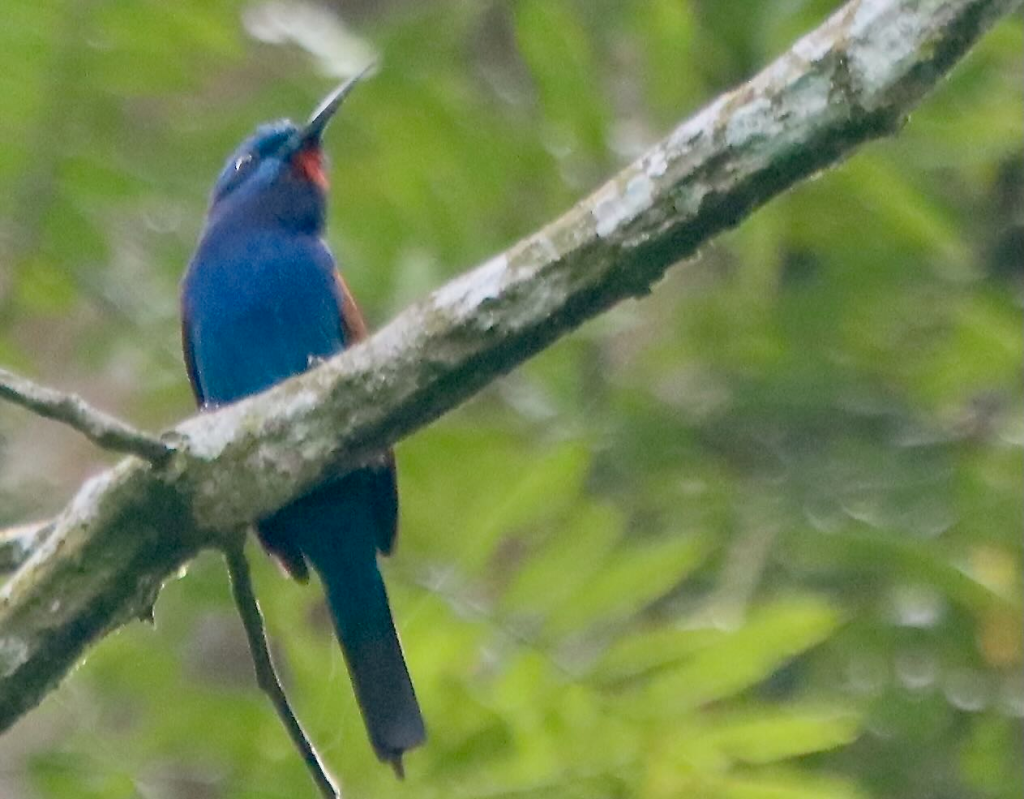
Fewer than 500 people worldwide have reported seeing this African bird – a blue-moustached bee-eater. Photo by Marc Chelemer
By Jim Wright
Special to The Record | USA TODAY NETWORK – NEW JERSEY
Remember Marc Chelemer? I last wrote about this dapper birder extraordinaire two-and-a-half years ago, when his consecutive birding streak approached 1,000 days.
I recently checked in again with Marc to see how he’s doing. For a mere mortal birder like me, it was a humbling experience.
Consider: As Feb. 19, the Tenaffy resident has birded for 1,878 days in a row, as per his eBird reports.
Marc’s life list is now 3,724 species, which ranks him 906th worldwide – out of more than 1.2 million eBirders. His most recent lifer: a short-billed gull, a bird of the Canadian Northwest and Alaska. Another birder found it on Raritan Bay in late December.
As for his nemesis bird – the bird that keeps eluding him – it’s still a south polar skua.
“In all the pelagic trips I’ve taken over the last decade, I’ve never seen one,” Marc says. “It’s the last remaining ‘common’ pelagic species that one is expected to see in New Jersey that I’ve never encountered.”
Marc’s best day is still from May 2023, when he saw 183 species during New Jersey’s World Series of Birding, but he did have 111 species one day last month, “which I think is pretty darn good for a winter’s day.”
The most unusual bird that Marc tallied recently is the blue-moustached bee-eater, which he saw in Ghana in November 2024. Marc notes that eBird shows that fewer than 500 people have ever observed this bird, whereas the number for Blyth’s tragopan, his previous rarest bird, is now more than 1,000.
With all that experience, what’s his advice for aspiring birders? “Learn birding by ear as much as possible. I find even today that my ability to identify birds by their sound FIRST, before seeing them, is a great advantage. Even if one can’t identify the bird, just training one’s ear to pick up small bird sounds will aid in trying to find them in a bush, a tree, or a field.”
When it comes to his birding streak, Marc says the sky’s the limit: “I see no reason to stop at 2,000. To me, this now seems like a life’s endeavor: Until such day as I am completely unable to use my eyes and ears to find a bird…regardless of weather or circumstance, I’m going to keep my streak going.”
Why does Marc love birding so much?
His answer: “Birds are amazing creatures. They’re so well adapted to the way they live, they seem impervious to cold, and they can fly. And because birds can fly, they, can move across the planet in ways that we have to work very hard to do. We’re unlikely to ever see an African elephant in Cape May, but we just might see an African reef-heron someday!”
The Bird Watcher column appears every other Thursday. Jim’s next book, “The Peregrine Falcon,” arrives in late April. Email him at celeryfarm@gmail.com.

March 3, 2026
February 27, 2026
February 20, 2026
February 2, 2026