
March 12, 2026
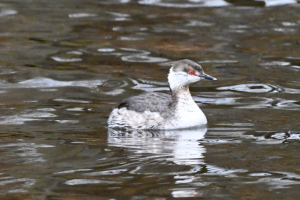
Horned Grebe at the Celery Farm
My first ever here. And the spring arrivals are arriving! The grebe was No. 186 on my Celery Farm life…

This Sunday marks the 75th anniversary of the death of the incredible ornithologist Frank Chapman (1864-1945), one of the most influential naturalists and birding writers in history.
Chapman started the Christmas Bird Count. He founded the forerunner of Audubon Magazine. He was the first curator of birds at the American Museum of Natural History in NYC, where he helped develop the modern diorama. (The video on Chapman above, by the American Museum of Natural History, was narrated by the AMNH's Steve Quinn of Ridgefield Park.)
Chapman fought for laws to protect wild birds from wanton slaughter for the millinery trade and large-city markets. And he helped to save the Everglades. To name a few of his achievements.
In his honor, Bergen County Audubon is sponsoring a walk on that day along the trail that bears his name in his hometown of Teaneck.
I found the following in the Jan.-Feb. 1946 issue of Audubon Magazine, and thought I'd share it here. (I hope that's OK.)
FRANK MICHLER CHAPMAN
A tribute and a valedictory by Ludlow Griscom, Chairman of the Board, National Audubon Society
THE passing of a rarely gifted personality, the termination of a highly successful career, are sad events. These enable the thoughtful man to reflect on the services rendered by such a life and to voice not only his own personal debt of gratitude, but also describe the benefits which have accrued to an ever-widening circle of people.
Frank M. Chapman, who died November 15, 1945, led such a life. Starting in 1886, full of ambition, his career very carefully planned, he succeeded in everything he undertook and attained every objective in at least six different activities, any one of which would have been a creditable career for the average individual.
A civilized society rightly demands something extra from those whom it adjudges to be "great." It is not enough to have realized a worthy ambition or to have attained outstanding excellence in some profession or special branch of knowledge. There must be a vision, a cause or belief to fight for and to win; in short, a selfless motive for public service. Chapman's native insight and the pressure of the circumstances of his youth combined to instill this principle in him.
Chapman never went to college, just why I do not recall. His father's early death left him about $2,000 a year, but he entered the American Exchange National Bank, where he worked diligently, and by 1886, was placed in charge of a department.
There was no question left but that steady advancement and success were assured. In the meantime, he had developed an overmastering interest in and love of birds, which could not be denied, so that he resigned his position. He had, however, received a training in practical affairs which was invaluable in later years.
In those days only a few "queer cranks" studied birds. Practically everyone Chapman knew thought he was ill-advised. He set out to prove he wasn't. Moreover, he had no intention of leading the completely self-indulgent, shut-in life of the average specialist of the day. He believed that birds were beautiful, interesting and valuable, that they should be conserved, and that their study constituted an ideal hobby and source of pleasure for an unawakened public. His career was in part a crusade to sell this idea.
The best energies of twenty years of his life were devoted to this purpose. The fun of exploring expeditions, discovering new birds, and writing technical ornithological reports, was for him a form of self-indulgence, which he deliberately kept in check until he felt he had really earned the right to pursue it.
To attain his goal, no stone was I ever left unturned. An enormous capacity for hard work, ingenuity, and originality of ideas were brought to bear. Chapman became an author, editor, lecturer, and photographer.
Seeing the need for certain types of popular books on birds, he wrote them himself, instead of wishing they existed. Seeing a useful role for a bird magazine which would act as the organ of the Audubon protection movement, he founded, financed, and edited Bird-Lore for 35 years.
When chronic cigarette smoking affected his throat, and the lecturing he believed useful was impaired, he just stopped smoking for life. He was one of the first men in the world to apply photography to bird study, and when something besides the camera and plates was required, he developed the necessary apparatus himself.
Believing that the old-fashioned rows of stuffed birds on perches were devoid of popular appeal, he devised the changing-seasons exhibit, and later invented the "habitat group," 1 now a standard method of museum exhibition throughout the world. There is, however, an important proviso; it is very expensive and the institution must be able to afford it. The American Museum of Natural History could not afford it, so Chapman raised the money for most of the earlier bird groups himself.
Chapman's campaign for bird study was of inestimable value to the Audubon movement, as he was the real trail breaker. He was associated with it from the very beginning and knew intimately such personalities as William Dutcher, George Bird Grinnell and Mabel Osgood Wright. His magazine became its organ.
He was one of the original directors of the National Association of Audubon Societies in 1905, and served on the Board for 32 consecutive years.
On his retirement as chairman, he turned over to the Society the world's most successful popular bird magazine, Bird-Lore. The idea of federal bird sanctuaries, which later expanded to the wildlife refuge program, stems from Chapman's influence in persuading President Theodore Roosevelt to declare Pelican Island, Florida, a reservation in 1904.
In the second half of his career, Chapman became internationally famous as an exploring naturalist, ornithologist, and zoogeographer, raising much of the money for his expeditions himself. He lived to become the dean of American ornithologists, and was elected to the National Academy of Sciences for his studies on the origins of Andean bird life. It was my great privilege to be his assistant for ten years of this period.
He regarded taxonomy and systematics as a means to an end, and wasted no time on non-essentials. He had trained himself not to burden his memory with facts which could be looked up in two minutes. About the time his book on the birds of Ecuador was printed, he could not remember whether a certain species had occurred in the country or not, he had no idea of its earliest correct name, no opinion as to which genus it should be referred. He had either forgotten about some of the birds he had himself described as new, or could not recollect their distinctive characters. He was through with Ecuador, and his mind was full of ideas and plans for some new project.
In 1887 Chapman happened to spend some time at Gainesville, Florida. There he encountered a young lad by the name of T. Gilbert Pearson, later earning his undying gratitude and devotion by helping along his congenital interest in birds.
In 1904, the writer, then a boy of 14, was introduced to Chapman in his museum office by Prof. Henry E. Crampton of Columbia.
I had all of Chapman's books to date and was an original subscriber to Bird-Lore. I like to think that our relations in later years were in part conditioned by our mutual astonishment at that meeting.
It so happened that my local bird studies had ceased upon coming to New York City to live in 1901. Somehow or other I had embarked on a compilation of the birds of Java! After the usual preliminary formalities, Chapman asked what he could do for me. I explained my project, remarked that I was at the end of my resources, and asked for help. Never again did I see Dr. Chapman so astounded.
It was my turn next to be amazed at discovering (a) that the great man knew nothing about the birds of Java and (b) that he professed to know nothing about any Old World birds! He never forgot the incident, and even 30 years later loved to tell the story of the absurd little boy and the birds of Java.
From 1917-1927, I was in almost daily contact with Dr. Chapman. I also saw much of Dr. Pearson, and we contracted a warm friendship.
In these pages of the book of my mind's eye, I meet both men face to face. As acting head of the National Association of Audubon Societies Dr. Pearson felt that he was reasonably competent to handle its affairs provided that from time to time he could talk things over with Chapman and get some advice.
After one such interview he stopped for a chat with me. With tears in his eyes he told me what he owed Chapman and exclaimed: "How I admire that man. I too was born with a love of birds, but he forgets more about them in a year than I will ever know. He is unique among living ornithologists in another respect. Throw him penniless on Broadway and in ten years he would own both sides of the street!" How creditable a story to both men.
The year 1945 has waxed and waned, and Frank Michler Chapman has gone to his final rest. Some of his earlier popular books have served their purpose. The rapid march of science has already rendered many of his technical ornithological papers, reports, and notes out-of-date, as he well knew was inevitable. But—
Chapman happened to tell me years ago that one of his favorite poems was the Psalm of Life. One of the famous stanzas mirrors his fundamental approach to life and his criterion for success:
Lives of great men all remind us We can make our lives sublime, And, departing, leave behind us Footprints on the sands of time.
Frank Michler Chapman—hail and farewell!

Chapman was amazing — way ahead of his time. Good luck with your Ted Parker project. I see his name pop up in research from time to time. Wil let you know if I come across anything interesting.

Thanks so much for this post, Jim!! Marvelous stuff by Griscom!! –And, oddly enough, I was just perusing a Chapman volume when this post showed up in my google feed!! (Big Bird really is watching, I think! ?)
March 12, 2026
March 5, 2026
March 3, 2026
February 27, 2026
2 comments
Jim Wright
Chapman was amazing — way ahead of his time. Good luck with your Ted Parker project. I see his name pop up in research from time to time. Wil let you know if I come across anything interesting.
Gregg Gorton
Thanks so much for this post, Jim!! Marvelous stuff by Griscom!! –And, oddly enough, I was just perusing a Chapman volume when this post showed up in my google feed!! (Big Bird really is watching, I think! ?)