
March 5, 2026
The Sky’s the Limit for This Birder
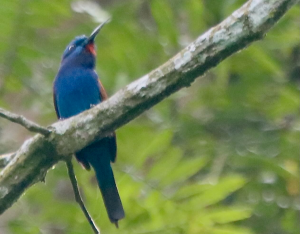
Fewer than 500 people worldwide have reported seeing this African bird – a blue-moustached bee-eater. Photo by Marc Chelemer By…

Not to rain on anybody's Red Fox parade, but I ran into Fred Virrazzi of National Biodiversity Parks, a non-profit land preservation and ecological
management firm.
He was less enthusiastic about Red Foxes than I was… I asked him to elaborate in an e-mail, which he did…
Writes Fred: "We often see the Red Fox almost worshiped by birders, photographers and the general public.
"Certainly they are a charismatic and striking species, but a 'cuddle factor' shouldn't cause us to abandon a certain level of caution before we fully embrace another possible invasive species in New Jersey.
"Purple Loosestrife can also produce a striking picture.
"There is strong evidence that the Red Fox was either never
in most parts of New Jersey or all of New Jersey and at the
very least was augmented by Colonial releases. Settlers were
dissatisfied with the native Gray Fox, which would tree after very short chases
while the Red Fox would just keep running.
"Red Foxes
are omnivores and as such would by definition be competing with many native
species such as owls and hawks. It must at least be considered that they
may be more prone to disperse certain damaging European origin and other
non-native weeds, seeds and pods/fruits.
"Naturally if they
are fed by humans, which has happened in many places in NJ including places like
Sandy Hook National
Gateway Park
and Island State Beach Park, their numbers can
swell adversely impacting native nesting ground birds such as ducks, grouse,
quail, terns and shorebirds. Some of these species are endangered.
"Ecology is
too complex to determine what may be one of the earliest mammal invasives,
besides man's, impact on the neoworld.
"Its false or elevated
portrayal to great indicator of habitat quality at the expense of the Gray Fox
and other native species might need an attitude adjustment."

Like to hear more on how a ravine was developed, but anything can happen with a permit.
Again, there is the cute cuddle factor here and it makes it hard to accept that Red Fox IS Probably an INVASIVE and as such ecological damage can be excessive.
The managers of parks must make these hard decisions; leaving Red Foxes is not biomass neutral. You do not get 20 Kg of fox without other native predators having their biomass reduced (e.g. killed). Also native prey including your local Wood Ducks, Coots, Gallinule and migrating American Woodcock, declining Northern Bobwhite, Wild Turkey and disappearing Ruffed Grouse can have further declines if Red Fox numbers are assisted by misguided humans feeding them or acclimating them to humans.
If you assist them or protect them or put them on a pedestal above other species you will be killing other animals and causing other species to be extirpated. If control is needed than I believe the USDA has a service.
If you decide on no control and fox are not in balance or have some unfair advantage due to some careless neighbor either feeding them or in them getting to pet food you are killing many animals through your insistence “that nothing can be done”. Feral cats are terribly damaging and also should be tightly controlled.
Cats and fox are efficient killers and there are examples of them being guilty of killing more than is eaten
http://digitalcommons.unl.edu/cgi/viewcontent.cgi?article=1034&context=icwdmhandbook
I am not saying you have a problem but these things are hard to detect. Losing the few migratory stops and breeding areas for birds in Bergen County should not be dismissed. Migrants are dropping because of the cumulative effects of many hazards.

And, development has forced them out of places they have lived for years — such as the ravine in Wyckoff. Where are they going to go?

I don’t think they should be dismissed as a pest or invasive species. Yes of course humans shouldnt feed any wild animals – deer,fox,squirrels, etc. But what are we supposed to do, get rid of them? Let them go naturally. Ferals cats do alot of damage to the local wildlife too and but that’s directly caused by people and there’s little done about that.
March 5, 2026
March 3, 2026
February 27, 2026
February 20, 2026
3 comments
FV
Like to hear more on how a ravine was developed, but anything can happen with a permit.
Again, there is the cute cuddle factor here and it makes it hard to accept that Red Fox IS Probably an INVASIVE and as such ecological damage can be excessive.
The managers of parks must make these hard decisions; leaving Red Foxes is not biomass neutral. You do not get 20 Kg of fox without other native predators having their biomass reduced (e.g. killed). Also native prey including your local Wood Ducks, Coots, Gallinule and migrating American Woodcock, declining Northern Bobwhite, Wild Turkey and disappearing Ruffed Grouse can have further declines if Red Fox numbers are assisted by misguided humans feeding them or acclimating them to humans.
If you assist them or protect them or put them on a pedestal above other species you will be killing other animals and causing other species to be extirpated. If control is needed than I believe the USDA has a service.
If you decide on no control and fox are not in balance or have some unfair advantage due to some careless neighbor either feeding them or in them getting to pet food you are killing many animals through your insistence “that nothing can be done”. Feral cats are terribly damaging and also should be tightly controlled.
Cats and fox are efficient killers and there are examples of them being guilty of killing more than is eaten
http://digitalcommons.unl.edu/cgi/viewcontent.cgi?article=1034&context=icwdmhandbook
I am not saying you have a problem but these things are hard to detect. Losing the few migratory stops and breeding areas for birds in Bergen County should not be dismissed. Migrants are dropping because of the cumulative effects of many hazards.
Carol Flanagan
And, development has forced them out of places they have lived for years — such as the ravine in Wyckoff. Where are they going to go?
Carla
I don’t think they should be dismissed as a pest or invasive species. Yes of course humans shouldnt feed any wild animals – deer,fox,squirrels, etc. But what are we supposed to do, get rid of them? Let them go naturally. Ferals cats do alot of damage to the local wildlife too and but that’s directly caused by people and there’s little done about that.