
March 5, 2026
The Sky’s the Limit for This Birder
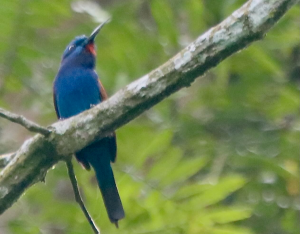
Fewer than 500 people worldwide have reported seeing this African bird – a blue-moustached bee-eater. Photo by Marc Chelemer By…

The pied-billed grebe is one of North Jersey's oddest visitors. Photo credit: John Pastore
My latest column is all about Pied-billed Grebes. I actually saw two at the Celery Farm this month… Always a treat. You can read the column here:
Now is the time to glimpse this elusive bird
.By Jim Wright
Special to The Record | USA TODAY NETWORK – NEW JERSEY
I call them “now-you-see-’em” birds. Most of us see them briefly once or twice a year, and then we don’t – often for a long time.
The designation includes the brown thrasher, the two cuckoos, and the pied-billed grebe.
Of the three, my favorite is the grebe: small, zephyr-like, seldom seen and as silent as a tombstone.
The “now-you-see-’em” description is particularly apt for the grebe. As you watch it swim in a pond or a tidal impoundment, it will disappear underwater for several seconds while it chases a little fish and other noshes. Cornell’s All About Birds website describes this dark-brown, goofy-looking bird perfectly: “part bird and part submarine.”
Earlier this month, I was delighted to see one in the post-dawn gloom at my local natural area. I was even happier that the bird stuck around long enough for me to take a photo of its silhouette.
When I posted the grainy image online, some folks said it resembled the Loch Ness Monster. And it does. But if an actual pied-billed were much smaller, it would resemble a child’s bathtub toy.
Incredibly, the coolest thing about this grebe is visible only when it leaves the water – which doesn’t seem to happen when most folks are watching. The grebe’s toes are lobed, which means the toes look like paddles and do a terrific job of propelling the little guy through the water.
The other nifty feature: While many bird species change their plumage during breeding season, the pied-billed grebe changes its beakage, and its bill becomes splotchier.
Grebe sightings are typically hit-or-mostly-miss in this region, but your best chances are in the coming months. According to Bill Boyle’s authoritative “Birds of New Jersey,” these grebes are common winter residents.
Alas, the grebe is also considered endangered in the Garden State when breeding because, according to Boyle, much of its fresh-water habitat for nesting was “steadily destroyed and degraded during the 20th Century.”
In case you’re wondering, the ”pied” part of its name comes from the markings on its dainty silvery bill, which you usually need a spotting scope to see.
“Pied” once meant having blotches of two or more colors. That’s true – during breeding season – but I’ve never been one to object to someone using poetic words. Gerard Manly Hopkins’ classic poem “Pied Beauty” comes to mind.
The term is rare enough that when Jerry Barrack, Doug Goodell, and I wrote “In the Presence of Nature,” our coffee-table book about the Celery Farm Nature Preserve in Allendale, I identified the bird as a “pie-billed” grebe in the caption.
Fortunately, a friend asked birding legend David Sibley to read the page proofs, and he gently pointed out my error. Although I turned cherry-pie red in embarrassment, I was grateful. That’s the kind of goof I'd never live down.
P.S. Guess what bird I’ll go as on this Halloween.
The Bird Watcher column appears every other Thursday. Email Jim at celeryfarm@gmail.com.
March 5, 2026

March 3, 2026
February 27, 2026
February 20, 2026