
March 5, 2026
The Sky’s the Limit for This Birder
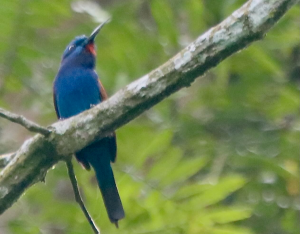
Fewer than 500 people worldwide have reported seeing this African bird – a blue-moustached bee-eater. Photo by Marc Chelemer By…

By Jim Wright
Special to The Record | USA TODAY NETWORK – NEW JERSEY
My previous “Bird Watcher” column featured a photo of a strange-looking bird, along with a caption that asked readers if they could identify it.
Several folks succeeded, including a birder who aimed his Merlin app at the photo. But as one reader asked, “What is that bird with the sweeping top feathers – whatever they're called."
That bird is a yellow-crowned night heron, and it sure invites questions Why is it called a night heron? Are we seeing more of them? Do they migrate?
For the low-down, I asked Hugh Carola, program director at Hackensack Riverkeeper. His replies have been edited for space.
What makes it a “night” heron?
Because they (and their black-crowned cousins) typically hunt at night. Yellow-crowns tend to prefer crabs (or crayfish if nesting on/near freshwater).
Do yellow-crowns migrate?
Absolutely, and mainly to the Southeast Atlantic and Gulf coasts, and to the Caribbean, especially Cuba. Like most birds that feed on aquatic prey, they don’t have to migrate far – just to where the water is ice-free and the prey is abundant.
Is their population expanding?
In the NY-NJ Harbor estuary region, most definitely. And it’s been going on for decades. Secaucus has been home to a slowly growing colony (22 pairs this year) at Harmon Cove. The NYC Bird Alliance has learned of a new colony in the Bronx, and more than a dozen yellow-crowns have been nesting in “street trees” in Bayonne in recent years.
One could reasonably assume that as many as 200 pairs may nest in our region.
How can you tell the male from the female?
You can’t. They’re identical.
What are those long feathers on top of their head? What's their purpose?
They’re the birds’ breeding plumes. Mature adults grow these feathers each breeding season to attract mates.
What’s the coolest thing about yellow-crowns?
They’ve somehow figured out that humans aren’t a threat – and they’ve exploited that reality to the species’ great benefit. I mean, nesting in street trees in Bayonne? But it works, and so they and their progeny will keep on doing it. It’s micro-evolution in front of our eyes.
Anything you’d like to add?
Yes, but it’s a bit of a downer. While yellow-crowns are thriving here, black-crowns are not. In the mid-1980s, they were the most common of the Harbor Herons. It’s now estimated that the species has declined by at least 50 percent.
If current trends continue, black-crowned night herons will be extirpated from the NY-NJ Harbor estuary region by 2035. And no one knows why. Unfortunately, these birds didn’t just go somewhere else. They’re just gone.
*
Readers, do you have a solar-powered bird-feeder cam? For a future column, I’d like to talk with readers who have installed one. Please email me.
The Bird Watcher column appears every other Thursday. Email Jim at celeryfarm@gmail.com.

Thanks, Hugh. Great info, and any tip of the hat to Stiles always makes my day.

Thank you Jim for the opportunity to contribute to your column. If I may, here are a few more bits of info about the real success story that is the Yellow-crowned Night Heron in the NY/NJ harbor estuary:
1. Virtually all breeding YCNH pairs do so on mainland sites, as opposed to the “Harbor Heron” islands in NYC which is where most other large herons nest (see https://nycbirdalliance.org/our-work/conservation/birds-of-ny-harbor for more).
2. In addition to Harmon Cove in Secaucus, the new colony in the Bronx, and the ~15 nesting pairs in Bayonne, two of the biggest colonies are at the Redfern Houses in Brooklyn and Warinanco park in Roselle. Only TWO pairs were counted at an island colony in 2022, during a full-region survey by NYCBA and NJ Audubon.
3. YCNHs are no stranger to the CF and NW Bergen area. Back in the 90s at least two pairs nested there; one in Allendale and another in Waldwick. That’s why I would not be surprised if the bird/s seen at the CF are nesting there or nearby. FYI it was Stiles Thomas himself (of course!) who noted them. 🙂
March 5, 2026

March 3, 2026
February 27, 2026
February 20, 2026
2 comments
Jim Wright
Thanks, Hugh. Great info, and any tip of the hat to Stiles always makes my day.
Hugh Carola
Thank you Jim for the opportunity to contribute to your column. If I may, here are a few more bits of info about the real success story that is the Yellow-crowned Night Heron in the NY/NJ harbor estuary:
1. Virtually all breeding YCNH pairs do so on mainland sites, as opposed to the “Harbor Heron” islands in NYC which is where most other large herons nest (see https://nycbirdalliance.org/our-work/conservation/birds-of-ny-harbor for more).
2. In addition to Harmon Cove in Secaucus, the new colony in the Bronx, and the ~15 nesting pairs in Bayonne, two of the biggest colonies are at the Redfern Houses in Brooklyn and Warinanco park in Roselle. Only TWO pairs were counted at an island colony in 2022, during a full-region survey by NYCBA and NJ Audubon.
3. YCNHs are no stranger to the CF and NW Bergen area. Back in the 90s at least two pairs nested there; one in Allendale and another in Waldwick. That’s why I would not be surprised if the bird/s seen at the CF are nesting there or nearby. FYI it was Stiles Thomas himself (of course!) who noted them. 🙂