
March 5, 2026
The Sky’s the Limit for This Birder
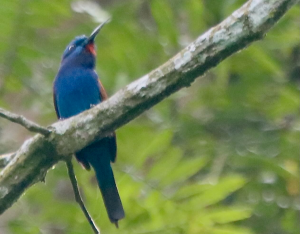
Fewer than 500 people worldwide have reported seeing this African bird – a blue-moustached bee-eater. Photo by Marc Chelemer By…

My latest column for The Record is all about Northern Mockingbirds — why they stopped singing, and while they'll soon sing again. You can read it here:
By Jim Wright
Special to The Record | USA TODAY NETWORK – NEW JERSEY
If you’re like me, you’re probably wondering why we seldom hear our local mockingbirds and their vast repertoires of songs in the dog days of August.
For an explanation, I talked with biology professor Dave Gammon of Elon University in North Carolina, who has studied northern mockingbirds for nearly two decades.
“The males sing more at certain times of year than others,” says Gammon. “Those unmated solo males in May? My goodness! They sing twice as much. I always tell my students, once these males find a mate, they’re boring.”
Gammon says the males stop singing once the females are on eggs because aside from attracting a mate, the male’s main reason for singing is to stimulate egg production.
“The females are exhausted this time of year because they’ll breed at least twice and sometimes three or four times,” Gammon explains. “Some of the best male songs come later in the summer. They’re shorter but they’re quite good.”
He says no one knows for certain why the males sing after nesting season: “Fall song is not going to lead to breeding, so why sing? My hunch is that’s when a lot of the learning [by young birds] takes place,”
Gammon, who hails from Utah, decided to study mockingbirds because of their musicality, which fit nicely with his musical background. What surprised him was how many basic things about them hadn’t been studied, like why these cousins of catbirds imitate some birds and not others.
“The answer is they imitate birds that sound like mockingbird song,” Gammon says. “There’s a template for what mockingbird song sounds like. It’s repetitive. Not too high or too low. Not too fast, not too slow. The songs of the Carolina wren and northern cardinal fit, while a dark-eyed junco’s song is too fast and a mourning dove’s is too slow.”
What would a male mockingbird sound like if it never heard other birds to imitate? Gammon likens it to a human toddler learning to talk: There’d be a lot of that babbling stuff.
“There hasn’t been a lot published about this,” Gammon says, “but what’s generally been found in songbirds is if they don’t have suitable model songs to copy, they sing sort of gibberish songs.”
Despite mockingbirds’ reputation for mimicking not only birds but everyday sounds like fire sirens or cellphone ringtones, Gammon thinks humans simply hear them wrong.
“We humans are really good at slapping meaning on things that don’t have meaning,” he says. “I’ve heard a mockingbird that sounds sort of like a car alarm, but I’ve never heard a car alarm in my neighborhood that sounds like that. We say that catbirds sound like cats, but would a catbird think it sounds like a cat? I doubt it.”
The Bird Watcher column appears every other Thursday. Jim’s next book, "The Screech Owl Companion," will be published by Timber Press in October. Email Jim at celeryfarm@gmail.com.
March 5, 2026

March 3, 2026
February 27, 2026
February 20, 2026