
March 5, 2026
The Sky’s the Limit for This Birder
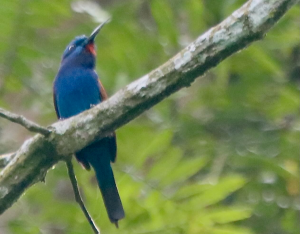
Fewer than 500 people worldwide have reported seeing this African bird – a blue-moustached bee-eater. Photo by Marc Chelemer By…

The Merlin Sound ID app can identify this red-winged-blackbird and a thousand other birds
by their calls. Credit: Ted Schroeder, Cornell Lab of Ornithology
My latest column for The Record is about Merlin, the app that is bringing birding to everyone — feauring an interview with Cornell Lab's Grant Van Horn.
You can read it here:
Sound ID, the Shazam for birds,' easy to use, free
By Jim Wright
Special to The Record | USA TODAY NETWORK – NEW JERSEY
In all my years of birding, I can think of no game-changer the likes of Sound ID, a remarkable addition to the Merlin app from the Cornell Lab of Ornithology. And it's free.
Often described as “the Shazam for birds,” the app can identify 1,054 North American birds by their songs and calls. Since its debut in 2021, it has been downloaded 13 million times.
Across North Jersey, from State Line Lookout in Alpine to DeKorte Park in Lyndhurst, I see people walking around holding up their phones instead of looking through their binoculars.
I recently talked with Grant Van Horn, a machine-learning researcher for Cornell, about the app and its ever-expanding database. The phone interview has been edited for space.
What is machine-learning?
It’s a field of computer science where the task is to teach machines how to do human-level tasks. That could be recognizing birds in a photograph or birds singing in an audio recording or teaching a car to drive itself on city streets.
The ability to identify so many birds by all their various sounds is impressive. How many audio files did it take to create a sound repertoire for all those birds?
We used more than a million sound files. If you played them all consecutively, they'd add up to four months of sounds.
Why is Sound ID so popular?
We tried as hard as we could to make it easy to use. You just push a button and it listens to real-time bird vocalizations. Achieving that in real-time is exceedingly difficult, but it makes for a magical experience.
Cornell has audio samples for most of the 10,000-plus birds in the world, and we could have released a sound model that covers most of those species, but it would have been very hard to maintain quality. So we did the reverse and concentrated on quality over quantity. We started with 400 species. We’ve increased it to over a thousand, and we’ll keep increasing that number over the years.
How do you identify the calls of a mimic like the Northern Mockingbird?
When Merlin Sound ID is running and a mockingbird is singing, the app will actually predict all these other species that the mockingbird is imitating, whether it’s a black-capped chickadee or a blue jay. It would be cool to see what sounds that mockingbird is reproducing, but that will require changes to the model and as well as the user interface.
What has been the biggest surprise?
Just how popular it has become, and how it has penetrated so many levels of society. It’s not just hard-core birders. It’s people from all walks of life with varying interest levels – kids and older people and everybody in between, using the system to learn about their local wildlife
The Bird Watcher column appears every other Thursday. Jim’s next book, "The Screech Owl Companion," will be published by Timber Press. Email Jim at celeryfarm@gmail.com.
March 5, 2026

March 3, 2026
February 27, 2026
February 20, 2026