
March 5, 2026
The Sky’s the Limit for This Birder
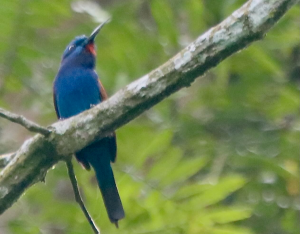
Fewer than 500 people worldwide have reported seeing this African bird – a blue-moustached bee-eater. Photo by Marc Chelemer By…

A male wood duck takes a swim at the Celery Farm Nature Preserve. Credit: Photo by Jerry Barrack
By Jim Wright
Special to The Record | USA TODAY NETWORK – NEW JERSEY
Wood Ducks are among the world’s most stunning ducks, and like so many of Mother Nature’s creatures, they often face a housing shortage. Thanks to Scott Weston, my co-author for “The Screech Owl Companion,” I may have found an answer.
A bit of background: The colorful waterfowl are called wood ducks because they once nested primarily in the hollows of trees. But as our human population expanded, the ducks were almost hunted to extinction by the late-19th century, and their habitat kept shrinking.
To remedy the situation, wood duck hunting was banned nationwide for more than two decades, and naturalists built large wooden nest boxes and put them high on trees near the water in their traditional nesting areas. The boxes also proved popular with raccoons that liked to pilfer duck eggs and for squirrels that wanted to nest there.
To thwart unwelcome intruders, the nest boxes were placed on poles on nearby ponds and streams or on poles with baffles to thwart unwelcome intruders. The only trouble was that these boxes were often hard to monitor and maintain, and the design’s wooden roofs tended to rot over time.
Like wood ducks, screech owls nest in trees and face the same housing challenges. My co-author, an owl expert, designed a nestbox with a steeply pitched roof that was squirrel- and raccoon-resistant.
Scott also started using a new product called Acre board, made of recycled rice hulls. It’s an effective building material for the boxes because the board’s surface is too slick for the squirrels and raccoons to hold onto. The product is expensive but highly durable. We realized that these new nestboxes, when slightly enlarged, should make perfect homes for wood ducks, too.
Another fascinating aspect of Scott’s design is a nod to traditional wood duck boxes. Inside each box is a little metal-wire ladder. Using its egg tooth and the little claws on its webbed feet, a newly hatched wood duckling can climb to the opening, jump and enter that wide, wild world of ours.
The question is, how will the wood ducks take to their new digs? To field test the latest design, volunteers at the Celery Farm Nature Preserve in Allendale built eight prototype nest boxes and placed them about nine feet off the ground on trees around the small lake in time for nesting season this spring.
With the help of a selfie stick, we plan to monitor the eight boxes to see which locations work best and how many eggs (fingers crossed) each nest box produces.
These are uncharted waters. We’ll learn more as we go along.
I plan to write about the project again after nesting season. In the meantime, I’d love to hear your thoughts.
The Bird Watcher column appears every other Thursday. Jim’s “Screech Owl Companion” was published by Timber Press. Email Jim at celeryfarm@gmail.com.

Great. Look forward to seeing them.

Thank you all! What an amazing endeavor. I hope it will be a great success!
March 5, 2026

March 3, 2026
February 27, 2026
February 20, 2026
2 comments
Cindy Waneck
Great. Look forward to seeing them.
Janet T
Thank you all! What an amazing endeavor. I hope it will be a great success!