
March 5, 2026
The Sky’s the Limit for This Birder
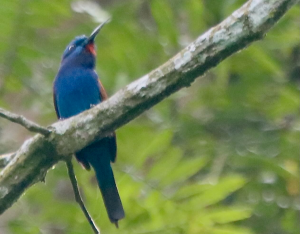
Fewer than 500 people worldwide have reported seeing this African bird – a blue-moustached bee-eater. Photo by Marc Chelemer By…

Imagine my surprise yesterday when I opened my mail at work and found an envelope filled with wonderful notes from the third-grade students at Ramsey’s Tisdale Elementary School.
Along with thanking me for visiting and talking about the Ace family of screech owls and reading from a couple of my books, they asked some very good questions (again).
Julie Anne, for example, wondered how I take pictures of the owls and deer without scaring them. Great question, and one weighing heavily on my mind right now.
Deer are tame, unfortunately, and I can’t seem to scare them away even when I try. They seem too comfortable around humans for their own good.
As for the owls, the shots inside the nesting box are with a tiny video camera that the owls aren’t even aware of.
The shots outside the box are taken with telescopic lenses, and we try to keep the use of flash to a minimum.
Someday soon, the owlets are going to jump out of the box for the world to see, and my biggest worry is that people will try to see — and photograph — the owlets in person when the owlets should really be left alone.
The cardinal rule is; The well-being of owls and other living creatures always is more important than any photograph.
Daniel noted how important it is to keep the wetlands safe, and drew a picture of a sign from the "Icky" book that says "No Pishing."
Everybody thinks the sign says "No Fishing," but Daniel got it right. "Pishing" is a funny noise that birders make to attract warblers and other small birds.
The "No Pishing" sign was a little joke, and Daniel picked up on it. Way to go.
James asked which I liked researching more, owls or wood ducks.
I guess I like researching screech owls a little more because so little is known about screech owls.
They operate mostly at night, and researchers don’t seem to get some information right about the owls.
I’ve read where incubation takes 26 to 31 days and begins after the first or second egg is laid. But it took 35 days after the first egg was laid and 33 days after the second egg for the eggs to hatch.
Joey asked if great blue herons eat eggs.
The answer, as far as I know, is no. I’ve seen them eat fish and frogs.
I will try to post some of the drawings accompanying the notes as soon as time allows. They are so nifty!
Thank you, Tisdalers!
March 5, 2026
March 3, 2026
February 27, 2026
February 20, 2026