
March 5, 2026
The Sky’s the Limit for This Birder
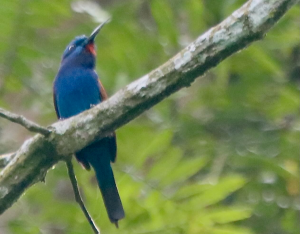
Fewer than 500 people worldwide have reported seeing this African bird – a blue-moustached bee-eater. Photo by Marc Chelemer By…

John Pastore writes:
Saw these Mallards Feb. 23, in Ramsey.
I was struck by their sapphire blue (rather than emerald green) heads, but I know that digital cameras sometimes 'see things in a unique way', depending how the light is hitting the subject. Especially something iridescent.
I did some Googling, and found a lot of people swear to have seen dark-blue-to-purple-headed mallards.
What say our local birding community?
Trick of the light, or a variant?

By the way, a similar structural color phenomenon is responsible for the blue of Bluebirds and Blue Jays. More birds to check out, John!

Trick of the light!

Thanks Diane. I will be paying more attention to Mallards, to observe this phenomenon.
Trick of the light. Iridescent feather colors are due to the refraction of light in the feather — so-called “structural” (vs. “pigmented”) color.Depending on the position of the Mallard’s drake head relative to the viewer, the color will shift from purple to green. Same phenomenon with Grackles, Hummingbird gorgets, etc.
March 5, 2026

March 3, 2026
February 27, 2026
February 20, 2026
4 comments
Diane
By the way, a similar structural color phenomenon is responsible for the blue of Bluebirds and Blue Jays. More birds to check out, John!
COOX2
Trick of the light!
John Pastore
Thanks Diane. I will be paying more attention to Mallards, to observe this phenomenon.
Diane
Trick of the light. Iridescent feather colors are due to the refraction of light in the feather — so-called “structural” (vs. “pigmented”) color.Depending on the position of the Mallard’s drake head relative to the viewer, the color will shift from purple to green. Same phenomenon with Grackles, Hummingbird gorgets, etc.