


March 5, 2026
The Sky’s the Limit for This Birder
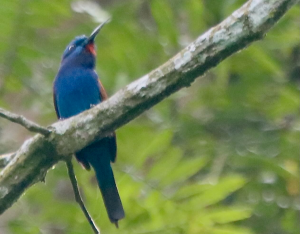
Fewer than 500 people worldwide have reported seeing this African bird – a blue-moustached bee-eater. Photo by Marc Chelemer By…

I wrote this for The Record maybe four years ago, but it seems to work right now, too, as birders are reporting seeing more than a dozen species of warblers at the Celery Farm…
Why warbler watching
is the best sport in town
When it comes to bird migrations, the real crowd-pleaser in these parts has traditionally been the autumn raptor show — with hundreds of broad-wings flying past a hawk watch on a brisk September day.
 But springtime offers an intriguing migration all its own: warblers, which have traveled from as far away as central South America and have been flitting through North Jersey’s open spaces in a great number and variety.
The tiny birds migrate by night, alighting after dawn to refuel on insects and worms.
For humans with sharp eyes, warblers provide a kaleidoscope of colors amid the greenery: vibrant mating plumages of yellows and reds and blues and oranges.
They come in dozens of exotic varieties, with names to match: Blackburnians and prothonotaries, Kentuckys and Cape Mays, blackpolls and redstarts.
Most people don’t notice warblers. They are, after all, weensy — maybe 6 inches long and weighing less than a duck sniffle.
(Click below to continue if the whole post is not visible)
They typically avoid bird-feeders.
They’re active mostly in the morning. Few actually do much warbling, and fewer still stay in one place long enough for the casual observer to see them.
Identifying them is even tougher. Although each species has distinctive plumage, calls, and idiosyncrasies, many tend to look alike.
The ability to spot, hear, and name them all is a gift — a few people just seem to be warbler savants — but mere mortals can improve their skills with practice.
Warbler watching has much to offer even those who aren’t avian-obsessed.
First of all, these really are beautiful little birds, seldom seen most times of year.
Second, allergies notwithstanding, now is a wonderful time of year for a morning walk in a nature sanctuary, even if you don’t find any black-throated blues or Ceruleans.
Just as important, warblers serve as another delicate reminder that it’s not human activity alone that makes this world go around — if we’d only stop once in a while and pay attention.

Thanks. I will try to post some shorter videos so they are faster to download.

Hi Jim and Pat
Congratulations..we watched the little fluffs sqeeking and moving. So cute. This is really great to see every day
jeri and frank swan

Either by the name “May Madness” or “Warbler Mania,” which is how I refer to it, for those who have been bitten by the bug, Warbler migration is a grand time. But as you allude to in your post, there is a more serious side to this as the decline in the Warbler population is a reminder of our need to be more responsible with the environment.
Vern

Looks like the same warbler I took a pic of at Campgaw Mtn. Palm Warbler. I also got a myrtle warbler at the Celery Farm the other day…
March 5, 2026

March 3, 2026
February 27, 2026
February 20, 2026
4 comments
Jim Wright
Thanks. I will try to post some shorter videos so they are faster to download.
jeri and frank sw an
Hi Jim and Pat
Congratulations..we watched the little fluffs sqeeking and moving. So cute. This is really great to see every day
jeri and frank swan
Vern
Either by the name “May Madness” or “Warbler Mania,” which is how I refer to it, for those who have been bitten by the bug, Warbler migration is a grand time. But as you allude to in your post, there is a more serious side to this as the decline in the Warbler population is a reminder of our need to be more responsible with the environment.
Vern
Pedro
Looks like the same warbler I took a pic of at Campgaw Mtn. Palm Warbler. I also got a myrtle warbler at the Celery Farm the other day…