
March 5, 2026
The Sky’s the Limit for This Birder
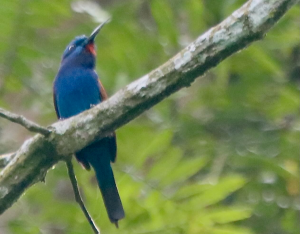
Fewer than 500 people worldwide have reported seeing this African bird – a blue-moustached bee-eater. Photo by Marc Chelemer By…

Earlier this month, a nature-lover wrote to me, saying that she saw a father and young son with nets trying to catch turtles in the Celery Farm Nature Preserve.
Aside from the fact that it's a nature preserve and not a pet shop where you can get whatever you want, my gut told me that it's a bad idea for other reasons as well.
I contacted Brian Zarate, turtle maven and supervising biologist for the NJDEP's Fish and Wildlife Endangered and Nongame Species Program, for his thoughts. Here goes:
The illegal collection of New Jersey’s wildlife is a constant threat. All of our state’s nongame species (those for which there is no legal season for harvest) are protected by the Endangered and Nongame Species Conservation Act (ENSCA) of 1973, which folks can learn more about here: https://dep.nj.gov/njfw/wildlife/regulations-and-resources/laws-and-regulations/endangered-species-conservation-act/).
ENSCA prohibits the “take” of nongame species from the wild, absent a permit issued by NJDEP Fish and Wildlife for conservation value purposes.
The take of a turtle, for example, could be someone driving along a road and finding a box turtle and bringing it home as a pet or could also include commercial collection at large scales for the larger pet trade. Either activity of take is prohibited. Either activity is detrimental to wild populations.
Turtle researchers and biologists have demonstrated through publications time and time again that the loss of even a small number of individuals from a population can be detrimental to the long-term persistence of that population.
This is true because turtles take a long time to reach adulthood and start breeding, many nests are predated, and many young turtles do not survive to adulthood. Population stability relies on adult turtles to live a long time and lay enough eggs in hopes of at least replacing themselves over likely many nesting seasons.
Any suspected illegal take of wildlife should be reported to our hotline: 877-WARN-DEP
Another form of “take” includes moving wild animals to new locations. Many of our species, including turtles, develop home ranges where they know where to find food, where to spend the winter months, where to lay eggs.
Most of the turtles we see in the wild are adult animals 10 years of age or even 50 or 60 and they’ve established patterns of behavior and movement over the course of many years. When we, as a sympathetic human, make a decision to move a turtle because we think it’s in a “bad” place we are disrupting what is likely a series of choices that turtles has made over perhaps decades.
Many relocated animals have home-ranging abilities where they attempt to find their way home when relocated, often putting them into greater peril than where they were in the first place, because now they don’t know where their safe spaces are and often have to cross unknown roads, lawns, parking lots, etc., they’ve never encountered before.
Yes, there are times when turtles end up in places that do require intervention, like the grassy median of a highway, but a turtle moving across a suburban, neighborhood road has probably been doing that for many, many years.
March 5, 2026

March 3, 2026
February 27, 2026
February 20, 2026