
March 15, 2026
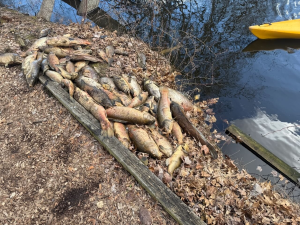
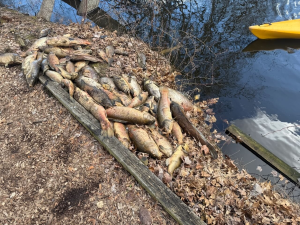
The Big Dead-Fish Clean-Up
A huge thank you to the volunteers who pitched in yesterday to remove all those dead fish from the Celery…

I came across this Eastern Box Turtle (above) this morning not far from the Celery Farm.
I had seen it about twenty yards away almost a week ago, before I left for the Azores. It looked OK but was moving lethargically.
As you can see, it is now missing some scutes.
When it failed to move much during the day, I called Conserve Wildlife Foundation, which suggested I contact the Woodlands Wildlife Refuge, who said:
I walked back to the site a half-hour later and the turtle was gone. I looked around and didn't see it, so here's hoping.
Thanks, Woodlands Wildlife Refuge! Link is here.

FYI, for future reference, Box Turtles do not shed or molt their scutes. The refuge must have been thinking about aquatic turtles that do. When Box Turtles and other species such as tortoises lose scutes, it is usually the result of injury (predation attempt or wildfire). The white material is exposed dead bone. Over time (years) a new layer of keratin and bone will regrow underneath the dead bone seen in your photos, then the outer layer will start to break off and chip away exposing the regenerated tissue. The new keratin will not look the same as it did before, but will restore the shell’s natural structure and function. It is amazing what wild turtles can survive and endure without medical intervention. While the information you received about the turtle molting was incorrect, leaving it alone was the right thing to do in this case 🙂
March 15, 2026
March 14, 2026
March 12, 2026
March 5, 2026
1 comment
KVB
FYI, for future reference, Box Turtles do not shed or molt their scutes. The refuge must have been thinking about aquatic turtles that do. When Box Turtles and other species such as tortoises lose scutes, it is usually the result of injury (predation attempt or wildfire). The white material is exposed dead bone. Over time (years) a new layer of keratin and bone will regrow underneath the dead bone seen in your photos, then the outer layer will start to break off and chip away exposing the regenerated tissue. The new keratin will not look the same as it did before, but will restore the shell’s natural structure and function. It is amazing what wild turtles can survive and endure without medical intervention. While the information you received about the turtle molting was incorrect, leaving it alone was the right thing to do in this case 🙂