
March 14, 2026
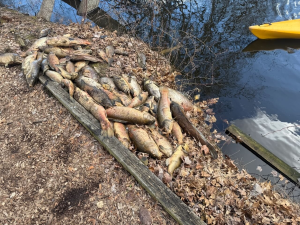
Massive Fish Die-off @ Celery Farm
A huge thank you to the volunteers who pitched in today to remove all those dead fish from the Celery…

I wrote this "Bird Watcher" column eight years ago, and it is still one of my favorites. (Kevin Watson took the photo above. Thanks, Kevin!)
The column features Mike Liamtola, who is leading the Woodcock watch at the CF on Saturday evening — meet at Green Way cul de sac around 7 p.m.
To introduce you to one of the goofiest birds on the planet, I offer this appropriately offbeat column.
Meet the American Woodcock, a robin-sized bird now appearing at a damp woodland near you.
How strange is Scolopax minor? Consider some of its many nicknames: “timberdoodle,” “bog-borer,” “big eyes,” “wood snipe,” and — my favorite — “mud bat.”
As the Cornell of Lab of Ornithology points out, the woodcock is a bit of a contradiction — a shorebird that likes the forest. Did I mention that its eyes are located toward the back of its head so it can better look around for predators while it dips its head to feed? Or that its ears are located between its eyes and bill?
My friend Mike Limatola, who has been leading a guided walk to see woodcock in the Great Swamp each March for more than a decade, says: “They like forest edges and open fields with brush and damp soil that attracts earthworms — their favorite food.”
By one account, the crawlers constitute 60 to 80 percent of a woodcock’s food intake — which proves you don’t have to be a European history buff to enjoy a diet of worms (or old jokes).
A woodcock is a worm-catching machine. A squat bird with big feet and a long bill, it reportedly stamps its feet to stir up the worms, then uses the outer portion of its bill like a pair of tweezers to extract its slimy prey from the ground.
I have read that the tip of its bill has sensors that can detect worm mucus in the ground for up to 24 hours. (I don’t know about you, but anytime I read the phrase “worm mucus” in a newspaper, I know I am living large.)
For Limatola, marsh warden of the Celery Farm Natural Area in Allendale, the attraction is simple: “I like these birds because of their unusual look – that long bill and those big eyes — and their beautiful coloration.” He says that these days the best time to see them and their spectacular courtship display is at dusk.
Ah, yes, that courtship display. The males put on moves that make your best TV dance-show contestant look downright mundane — and they announce their arrival in the twilight with a strange buzzing noise onomatopoetically called a “peent.” (You can’t make this stuff up.).
As for the display itself, it involves flying in circles as high as several hundred feet in the air while making odd chirps that the females apparently find irresistible.
I love this description of the courtship display by T. Edward Nickens, writing in National Wildlife more than a decade ago:
Suddenly, I hear it: a faint, trilling twitter like the turning of a rusty screw. The sound rises toward the sky, where it seems to hang suspended in the gloaming. And that's when I see the bird, a fist-sized ball of feathers orbiting high overhead: a woodcock.
The bird scribes two large circles, then suddenly cascades toward the ground like a falling leaf, chirping in the descent. He lands near a trio of tall cedars and struts about with a stiff-legged gait. Then the woodcock catapults toward the gibbous moon again, in an exuberant sky dance designed to attract breeding females.
March 14, 2026
March 12, 2026
March 5, 2026

March 3, 2026