
April 16, 2020
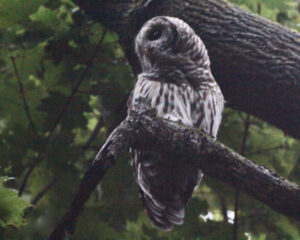
Earth Day, Stiles Thomas, and a Barred Owl
My column for The Record today is about Stiles Thomas and my most unforgettable birding moment, and why they matter…

Last week, I posted a couple of old articles about State Line Hawk Watch. Now it's time to give Mount Pete its due!
(Yes, that's John Brotherton.) The article is from 1989.
Area hawkwatchers have a field day
By LORRAINE ASH
From the top of Mt. Peter in Warwick, N.Y., all eyes are on the hawks flying overhead, particularly in September and October when the Bi-State Hawkwatch Coalition keeps the lookout manned daily.
John Brotherton of Mahwah, a member of the Fyke Nature Association in Wyckoff , was on duty Thursday, logging the temperature, wind speed, wind direction and other data.
"We do this every hour," he said, putting down his binoculars for a moment to write in his notebook. Data collected at this and other area hawkwatching posts, such as that on Hook Mountain in Upper Nyack, is sent to a central depository at Hawk Mountain in Pennsylvania. Along with statistics from across the nation, the information is made available to scientists and researchers.
"Hey, aren't they turkey vultures?" yells out a neophyte hawkwatcher from Greenwood Lake, who came to do some viewing and enjoy the morning sunshine. "Isn't that a red head?"
"No, that's a hawk," Brotherton responds.
"What about that over High Point? I'm going to guess that's a sharp-shinned."
"Yeah, yeah, yeah," Brotherton says slowly, surveying the area through his binoculars. "See that flap-flap-sail, flap-flap-sail."
So goes the day at the lookout, where the record number of broad-wing hawk citings was 6,658 Sept. 21, 1971.
"They're the most numerous here," Brotherton explains. "Some live and breed here, but most breed to the north. More than 2,000 were seen migrating here Sept. 14,- and another 2,000 last Sunday."
In fact, Sept. 14, 15 and 16 are the best days to see the birds in New Jersey, which is along the Atlantic fly way, a position that makes it an excellent state from which to birdwatch.
The type of hawk spotted second most frequently at Mt. Peter is the sharp-shinned, of which 337 were cited Sept. 29, 1986. These statistics come from the hourly logs kept by those posted on the lookout.
Most days visitors are likely to see the indigenous turkey vultures which, like other resident raptors, or predatory birds, are identifiable by their flight patterns. Those on a migration will sail through the area in one direction, but those who live nearby swoop, turn, circle and generally stay in the area on a search for dead animals below.
The best weather is when there northwesterly winds. The hawks, for whom the migration is a long and arduous event that could take weeks, want to go the longest distance while expending the least amount of effort.
"There may be days they don't eat," Brotherton said, "so they want to conserve energy."
Travel, then, is limited to the daylight hours because of the hawks' flying technique, that is, sailing on rising currents of air.
Birds which migrate at night simply flap all the way.
"During the day there are 'thermals,' or spirals of hot air that create an updraft," Brotherton explains, adding that the hawks like to get on top of these to get boosted upwards and for a little while sail effortlessly on top. Then they glide down in whichever direction they want to go.
Sometimes dozens, and even hundreds, of hawks are cited at the top of a thermal, a phenomenon called a "kettle."
For the avid hawkwatcher, the thrill of spotting the birds is as exciting as the challenge of identifying which type of hawk they are seeing.
In addition to the common broad-winged hawk, others seen in this area include the osprey or "fish hawk," the northern harrier or "marsh hawk," the sharp-shinned hawk, the red-tailed hawk and those of a smaller variety, such as the crow-sized American kestrel or Cooper's hawk. The red-shouldered hawk is endangered in New Jersey.
And later in the season spotting a northern goshawk can be a treat.
In color, most hawks are brown, gray or white. "But some are quite spectacular," said Brotherton. "Personally, I'm not addicted. I put in some time and enjoy it but there are those among us who hold on to their binoculars and are as excited at sitting at 3 p.m. as they were six hours before."
There are half a dozen enthusiasts in the ranks of the Highlands Audubon Society, a group comprised primarily of members from north Jersey and New York state. But the number of hawkwatchers can get as high as 40 on a heavy day in either September or October atop the mountains.
Local people who helped organize this year's bi-state hawkwatch, sponsored by the Fyke Nature Association as the thirty-first in the area, include Stiles and Lillian Thomas and Martha Webster, all of Allendale, and Judith Cinquina of Upper Saddle River.
April 16, 2020
October 3, 2017
September 22, 2015