
September 17, 2026
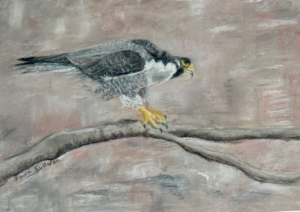
A New Painting of ‘The Beast’
A painting entitled "The Beast of State Line Lookout" now adorns the cafe there. The pastel by Laura Sullivan was…

This fascinating story from The Record on Sept. 28, 1965, features some terrific quotes from the legendary Stiles Thomas — and mentions the decline in Bald Eagles back then: "Ornithologists are worried that pesticides may be killing the birds, whose population has declined sharply in recent years."
I also love the fact that the story features a photo of my favorite — a Red-shouldered Hawk.
Hawks Switch Travel Pattern
ALLENDALE: Observations made atop Mt. Peter in Orange County, N. Y., during an 18-day census of migrating hawks turned up some strange departures from normal migration patterns, Stiles Thomas, chairman of the project, indicated last night.
A dozen or so hawk species are seen each year during the fall migration, Thomas said, and of them the most common by far is the broadwing, which migrates in flocks.
But this year there were more specimens of another species seen than there were broadwings,
By contrast, Thomas said, the number of sparrow hawks counted was double the previous high. The number of birds seen this year was about the average for the past seven years the census has been made, Thomas said.
Apparently the decline in numbers of broadwings was offset by increased numbers of sparrow hawks, Thomas said.
He had no explanation for the variations in species populations.
BALD EAGLES MISSED
No bald eagles were seen, Thomas said, although at least 1 and often 4 have been seen other years. Ornithologists are worried that pesticides may be killing the birds, whose population has declined sharply in recent years.
At Hawk Mountain, Pa., where many bald eagles have been counted in past years, Thomas said onlv 40 were counted this year and they were all adults, indicating that the birds had not successfully reproduced. Thomas said.
Mt. Peter is is one of the best vantage points in this area to observe hawks, Thomas said, because the birds seek out mountains, gliding from one to the next on the updrafting air currents mountains cause.
The birds start moving about 9 A. M., he said, after the wind has started up, and quit for the night about 5 P. M.
The blustier the wind the better hawks seem to like it, Thomas observed, but said the hawks seem to have no preference for a sunny day over a cloudy one.
The birds are masterful navigators of air currents, Thomas said, and are able to glide southwards regardless of wind direction.
The watch will be resumed from October 9 to 17 for the migration of red-shoulder and red-tail hawks, species that start their migration later than others, Thomas said.
The census is made by the Fyke Nature Association, and about 80 persons have participated in it this year.
It is done mostly for the pleasure and edification of those doing the watching, Thomas said, but the census data are forwarded to the U. S. Fish and Wildlife Service.
September 17, 2026
September 5, 2026
August 28, 2026

August 11, 2026