
September 17, 2026
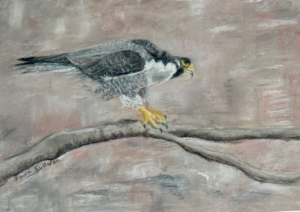
A New Painting of ‘The Beast’
A painting entitled "The Beast of State Line Lookout" now adorns the cafe there. The pastel by Laura Sullivan was…

Tail-wagging phoebes have been arriving in our region this month. Photo courtesy of Alice Leurck
My latest column for The Record is all about those recently arrived, tail-wagging eastern phoebes.
By Jim Wright
Special to The Record | USA TODAY NETWORK – NEW JERSEY
Any day now, I hope to see one of my favorite signs of spring: the eastern phoebe.
I love these elegant little birds because they like to nest near humans. I was heartened to read on the state’s top listserv for birders that phoebes started appearing just over two weeks ago, and others have arrived in our area.
One central New Jersey birder noted that her phoebe “returned to the yard this morning and went directly into the shed where it has nested for the past several years.”
Phoebes are in the flycatcher family, along with a bunch of small birds that look exasperatingly similar to casual birders like me. The alder and the willow flycatchers look so alike that the best way to tell them apart is by their songs, which is way above my pay grade without the Merlin sound ID app.
Phoebes seem a bit more compact, with very dark heads. When in doubt, check that tail. If it’s wagging, it belongs to a phoebe.
One of their claims to fame was that they were the first birds in America to get leg bands – more than 220 years ago. The artist John James Audubon had a hunch that the phoebes in his yard in eastern Pennsylvania were the same ones every year, so he tied pieces of silver thread to the legs of young phoebes. The following spring, he saw two phoebes that still wore the threads.
Audubon would be pleased to hear that a family of phoebes in Columbus, Ohio, has nested under a mausoleum portico for five decades. Now that’s what I call site fidelity.
Sometimes, I find phoebes nesting in kiosks in parks and natural areas. When I visited Pennsylvania’s Hawk Mountain Sanctuary each spring, I looked forward to seeing phoebes nesting in the trailhead entrance. It was just one of nature’s rhythms there that made me feel at home.
If you're lucky enough to have a phoebe nesting near you – typically in an eave on a porch or garage – don't remove the nest after the season ends. Like bald eagles, they like to use the same nest every year, perhaps with some alterations and minor redecorating.
“To be chosen by eastern phoebes means that you and your dwelling have not pressed too harshly on the living earth,” nature writer Ted Williams once noted. “Watch for these gray, bewhiskered fly-catchers hovering near the edge of your roof or perched on a nearby branch, tails pumping as both sexes shout their raspy, incessant ‘feebee’ or ‘feeble’."
By the way, if you hear a bird calling “fee-bee, fee-bee,” that may not be a phoebe. It could be a black-capped chickadee. If you can’t see the bird, use that Merlin sound ID app to tell them apart.
The Bird Watcher column appears every other Thursday. Jim’s latest book, "The Screech Owl Companion," was published by Timber Press. Email Jim at celeryfarm@gmail.com.
September 17, 2026
September 5, 2026

August 28, 2026

August 11, 2026