
September 5, 2026
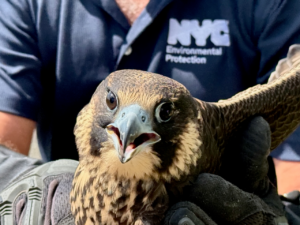
A Young Peregrine on the Ascent
Yesterday in the Mohonk Preserve near New Paltz, N.Y., Chris Nadareski of the NYC DEP released four young rehabbed peregrines,…

Last week I asked what kind of crustacean was crawling around a fort in Old Sn Juan.
I also wrote that I figured a bird must have carried it there since these guys don't handle steps well.
Jennifer Browning and Julie McCall both said it was a Hermit Crab. (Thanks!)
Julie added:
Coenobita clypeatus – a Caribbean hermit crab, often referred to as a purple pincher among hobbyists.
This one's pretty lucky for two reasons: 1. it actually found a shell to fit it. The number of shells being harvested in the wild to sell has an impact on hermit crabs! 2. it's in the wild.
Pretty much *EVERY* land hermit crab you see in captivity is taken from the wild. it is so incredibly difficult to breed them in captivity and have the offspring survive, that the pet trade exclusively sells kidnapped hermit crabs. Land hermit crabs are better off in the wild!!
Also, I can attest that their climbing abilities are very very impressive, and that crab probably did climb up on its own. they can climb up the inside of a glass tank if they use the corners.
I learn something new every day, and have a long way to go … Below is a shot of the crab in hermit mode. Bottom is a shot of the fort itself.

Thanks, Julie!

– clarification: I should have specified Ecuadorian Hermit Crab (Coenobita compressus) – as opposed to just a random crab of any species in Ecuador. 🙂
Deedee – I am not 100% sure, but knowing Caribbean Crabs and their shell preferences (they typically prefer shells with round openings rather than D-shaped openings, for example, unlike the Ecuadorian Crab’s usual opening preference) and taking a look at the shell and going through some photos online, I suspect it’s a mollusk in the Turbinidae family. In captivity, “turbos” are definitely a preferred shell among these guys.
Turbo castanea seems like a good possibility, given the shape, markings, and range, although I can’t be sure considering the degree of wear on this little dude’s home. 🙂
If I’m only considering shape and dimension, Lithopoma caelatum looks like it could be possible, but I think the markings are more consistent with Turbo castanea.
My mollusk ID skills are not particularly good. I spend most of my time simply trying to find shells that are actually big enough for my jumbo hermit crab. *laugh*
Yes, of course, but whose empty shell did that Hermit Crab occupy???
September 5, 2026

August 28, 2026

August 11, 2026
July 31, 2026
4 comments
Deedee
Thanks, Julie!
julie
– clarification: I should have specified Ecuadorian Hermit Crab (Coenobita compressus) – as opposed to just a random crab of any species in Ecuador. 🙂
julie
Deedee – I am not 100% sure, but knowing Caribbean Crabs and their shell preferences (they typically prefer shells with round openings rather than D-shaped openings, for example, unlike the Ecuadorian Crab’s usual opening preference) and taking a look at the shell and going through some photos online, I suspect it’s a mollusk in the Turbinidae family. In captivity, “turbos” are definitely a preferred shell among these guys.
Turbo castanea seems like a good possibility, given the shape, markings, and range, although I can’t be sure considering the degree of wear on this little dude’s home. 🙂
If I’m only considering shape and dimension, Lithopoma caelatum looks like it could be possible, but I think the markings are more consistent with Turbo castanea.
My mollusk ID skills are not particularly good. I spend most of my time simply trying to find shells that are actually big enough for my jumbo hermit crab. *laugh*
Deedee
Yes, of course, but whose empty shell did that Hermit Crab occupy???