
September 5, 2026
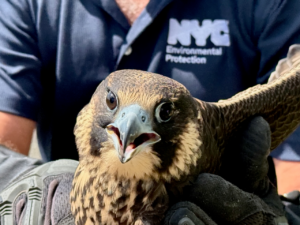
A Young Peregrine on the Ascent
Yesterday in the Mohonk Preserve near New Paltz, N.Y., Chris Nadareski of the NYC DEP released four young rehabbed peregrines,…

My latest column for The Record and other USA Today papers in New Jersey is an appreciation of grackles.
Yeah, you read it right!
You can read the column here:
By Jim Wright
Special to The Record
When I wrote about grackles (and my distaste for them) last month, I asked readers what they thought.
Of the folks who commented, most concurred that these iridescent blackbirds are feeder hogs. I also encountered a few grackle fans (bless ‘em) with the expected “They’re God’s creatures, too” and “They’re so beautiful…”
But beyond those purists who love all creatures great and small, some folks just see things a bit differently — often with a refreshing and thought-provoking slant.
One reply made me see grackles from a new perspective.
“I live in Clifton in the center of a rather large swath of suburbia,” writes Michael Lechicky. “By that, I mean rows upon rows of 1950's houses with no natural areas in between. So in my neighborhood, common grackles are not so very common as their name could imply. When they do show up at my feeders, not only are they an unusual (and therefore intriguing) sight, they also tend to show up only in pairs or groups smaller than 10, and then leave quickly, not to return again.”
Michael adds that he finds “their iridescent plumage enchanting, and I also think they're an interesting bird — not a red-winged blackbird, who pompously perches on reeds in marshes — but a bit of a skulker. Sometimes I see the grackles when I go for walks through the woods – flipping over leaves on the ground, or flying through the understory in groups of two or three. Where are they going?”
Michael finds it ironic that a bird that is evidently an annoyance to some intrigues him.
“To me, It is a bird symbolic of wet north Jersey woods, not backyards, because that is the only time I see it,” he writes. I do find it interesting how one's perspective of nature can be so acutely shaped by the place you happen to grow up in. What happens when that small bubble is the exception rather than the rule?”
Michael’s comments remind me of the time an odd-looking and rare-for-North-Jersey bird called a purple gallinule appeared at my local nature preserve two decades ago (and hasn’t been seen there since).
It was such an attraction that birders drove an hour or two in hopes of seeing a “life” bird.
A surgeon drove in his scrubs from Morristown 40 minutes away in hopes of catching a glimpse. I am embarrassed to say I may even have written some cringe-worthy doggerel about it, with a nod to “The Scarlet Pimpernel.”
After the gallinule moved on and the hoopla died down, a friend who used to live in Florida said, “You know, they’re so common down there that folks call ’em swamp chickens.”
The first rule of real estate, birding and apparently everything else: You got it. Location, location, location.
That’s why one birder’s bane is another birder’s rarity — and why we should never take any bird for granted.
The Bird-watcher column appears every other Thursday. Email Jim at celeryfarm@gmail.com.
September 5, 2026
August 28, 2026
August 11, 2026
July 31, 2026