
September 5, 2026
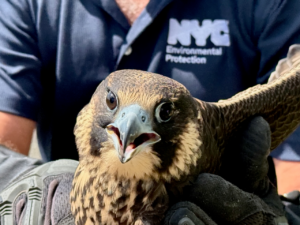
A Young Peregrine on the Ascent
Yesterday in the Mohonk Preserve near New Paltz, N.Y., Chris Nadareski of the NYC DEP released four young rehabbed peregrines,…

A white-throated sparrow calling, with an inset of the Sound ID app. CourtesyKevin Pero/Macaulay Library.
My latest column for The Record and other USA Today newspapers in New Jersey is all about the amazing new Sound ID app from the Cornell Lab of Ornithology. It has a few bugs but it is a game-changer.
Here's the column:
By Jim Wright
Special to The Record
For birders, it just might be the hottest app since eBird revolutionized the way people keep track of their bird sightings nearly two decades ago.
The app is called Sound ID, and it’s designed to help identify unseen birds by their calls and songs. It’s part of the free and revolutionary Merlin bird identification app umbrella from the Cornell Lab of Ornithology. It’s powered by a dataset of over 50,000 recordings from Cornell’s legendary Macaulay Library.
All you do is download and open the app, click “Sound ID” and press the big green microphone icon. The app will record all sounds for the next two minutes, suggesting identifications for the bird sounds that it hears along the way. It’s that simple.
The app is already paying unexpected dividends.
“One pleasant surprise is the feedback we have been receiving from folks with impaired hearing,” says Grant Van Horn, the lead researcher behind Sound ID. “The app is allowing them to experience bird songs again.”
One hearing-impaired birder wrote to Van Horn and said that he has used Sound ID extensively and has been impressed by everything, including the identifications, the accompanying spectrogram visualizations, and the convenience of exporting recordings to other devices or uploading to eBird.
Drew Weber, Merlin Project coordinator, says he has been gratified by “hearing all the stories of discovery from users who are identifying some species for the first time that had always puzzled them, or finding lifers that they had always wanted to see but overlooked because they didn’t recognize the song.”
Like any new technology, the app has some bugs.
Recently, I tested the app at a local marsh. Sometimes the app and I identified the bird’s call simultaneously (green heron). Sometimes the app helped locate a furtive bird I would’ve missed (common yellow-throat). But sometimes I heard birds that the app missed (distant blue jay). And sometimes it identified a bird that was likely a false positive (marsh wren, moments after a Carolina wren called).
It’s all part of the growing pains. “We know probably better than anyone the blindspots and problems, and we have a roadmap planned to rectify these,” says Van Horn.
A bigger problem arises when birders take the app’s results as gospel and enter them into citizen-science data-collection projects like eBIrd.
“We’ve been trying to communicate that Sound ID is another tool in a birder’s toolbox to help them identify the species around them,” says Van Horn. “This doesn’t mean that Sound ID’s suggestions can be taken on blind faith. Folks submitting checklists should still be careful to add species that they’re confident they observed, whether by getting a good look at the bird or by reviewing the recording they captured.”
He adds: “We’re at a good starting point and have a long road in front of us, but things will only get better from here.”
The app is awesome already.
The Bird Watcher column appears every other Thursday. Email Jim at celeryfarm@gmail.com.
September 5, 2026

August 28, 2026

August 11, 2026
July 31, 2026